Why Visit Monument Valley?
Few landscapes are as instantly recognizable as Monument Valley. Its towering red sandstone buttes and mesas, rising abruptly from a flat desert floor along the Arizona-Utah border, have become visual shorthand for the American Southwest itself — appearing in countless films, photographs, and advertisements for the better part of a century. Yet Monument Valley is far more than a scenic backdrop: it lies entirely within the Navajo Nation, remains home to Navajo families today, and carries deep cultural significance well beyond its role as one of the most photographed places on Earth.
This guide covers the valley's geology, its most iconic formations, how to visit both independently and with a guide, and how to approach a place that is simultaneously a world-famous landmark and someone's home.
What Is Monument Valley?
Monument Valley is a Navajo Tribal Park, not a unit of the U.S. National Park System, a distinction that surprises many first-time visitors. It's owned and managed entirely by the Navajo Nation, which means America the Beautiful passes are not accepted here, and the park's own entrance fees and regulations apply instead.
The valley itself is a broad, open expanse of desert punctuated by isolated buttes, mesas, and spires — the eroded remnants of a once-continuous layer of rock that has been worn away over tens of millions of years, leaving these dramatic formations standing alone across the valley floor.
Where Is Monument Valley Located?
Monument Valley sits directly on the Arizona-Utah border, roughly 24 miles north of Kayenta, Arizona, along U.S. Highway 163. The park entrance and visitor center sit on the Arizona side of the border, though many of the valley's most famous formations are visible from both states.
| Starting Point | Approx. Driving Time |
|---|
| Kayenta, AZ | 30 minutes |
| Page, AZ | 2 hours |
| Flagstaff | 2 hours 45 minutes |
| Grand Canyon South Rim | 3 hours 30 minutes |
| Sedona | 3 hours 30 minutes |
Geology: How the Buttes Were Formed
Monument Valley's formations are built from layers of sedimentary rock — sandstone, siltstone, and shale — deposited over roughly 50 million years as ancient rivers, dunes, and shallow seas repeatedly covered this region. Following the broader uplift of the Colorado Plateau, that once-continuous rock layer began eroding under the relentless combination of wind, rain, and temperature extremes typical of this high-desert environment.
Because erosion doesn't wear away rock evenly, softer layers eroded faster than harder, more resistant caprock above them, gradually isolating individual buttes and mesas as the surrounding softer material wore away entirely. Given enough time, today's mesas erode further into narrower buttes, buttes erode into slender spires, and spires eventually collapse altogether — Monument Valley's formations represent different stages of this same, ongoing erosional process, frozen at a single moment we happen to be witnessing.
The rock's deep red color comes from iron oxide within the sandstone, the same basic mineral process responsible for rust, while darker desert varnish — a thin coating of minerals deposited by water over centuries — streaks many of the formations' faces. For more on the deeper rock record connecting this region, see our Arizona Geology → and Colorado Plateau → guides.
The Mittens and Merrick Butte
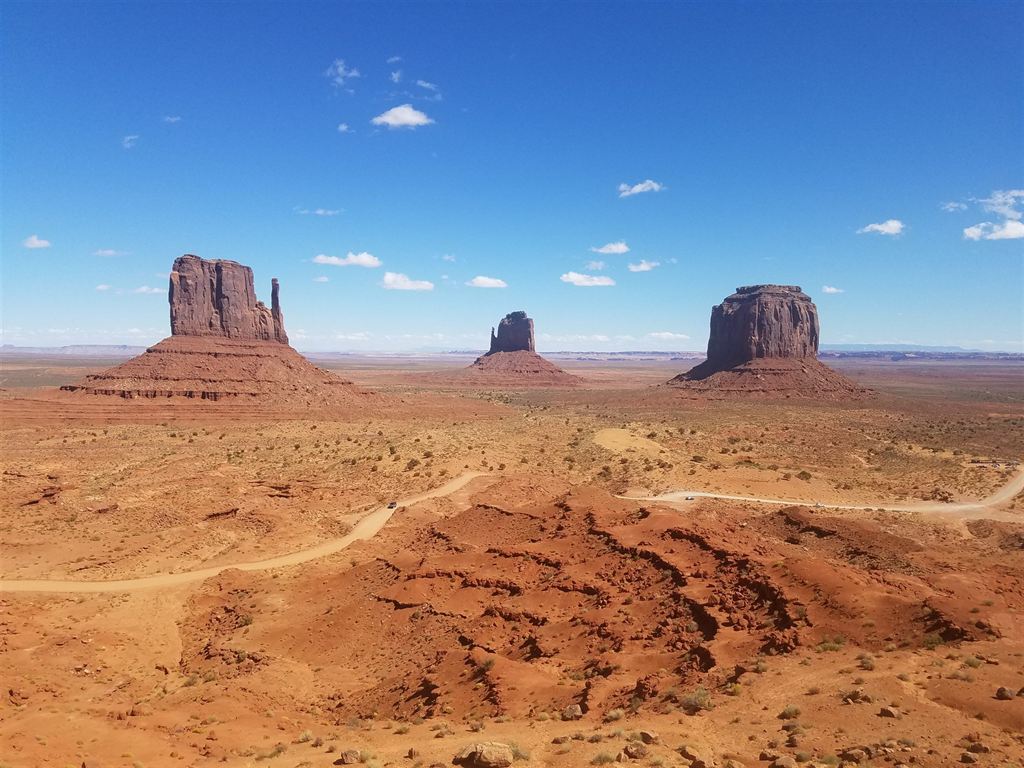
The valley's most photographed formations are the West and East Mitten Buttes, twin formations whose shape — a tall central mass with a single thinner spire beside it — resembles an upraised hand with a thumb extended, giving them their name. Alongside Merrick Butte, the third formation in this classic trio, the Mittens form the single most iconic view in Monument Valley, visible directly from the Visitor Center and appearing in countless films and photographs over the decades.
Beyond this famous trio, the valley contains dozens of other named formations — spires, arches, and mesas — each with its own Navajo name and significance, many of them visible along the Valley Drive loop.
Valley Drive: The Self-Guided Loop
A 17-mile unpaved loop road, Valley Drive, is open to visitors in their own vehicles, winding through the valley floor past the Mittens, Merrick Butte, and numerous other formations and named overlooks. The road is rough, dusty, and slow going — a high-clearance vehicle is recommended, and the full loop typically takes about two hours to drive at a careful pace with stops for photos.
Valley Drive covers only a portion of the valley's full expanse, giving independent visitors a genuine, if partial, look at the landscape without requiring a guide.
Guided Tours and Backcountry Access
Large sections of Monument Valley beyond Valley Drive are accessible only through guided tours led by licensed Navajo guides, who bring both vehicle access to restricted backcountry areas and cultural context about the valley's history, significance, and the Navajo families who continue to live there. Guided tours range from short scenic drives to multi-hour excursions including hiking, and many operate at sunrise or sunset specifically to catch the valley's formations in their most dramatic light.
For visitors who want to go beyond what Valley Drive alone offers, a guided tour is generally the only way to do so, and it adds a layer of understanding about the valley that a self-guided visit simply can't provide.
History and Navajo Connection
Monument Valley, known in Navajo as Tsé Bii' Ndzisgaii ("valley of the rocks"), has been home to Navajo families for generations, and many continue to live within the valley today, in some cases maintaining traditional hogans alongside modern homes. The valley was designated a Navajo Tribal Park in 1958, placing its management and protection directly under Navajo Nation authority rather than any federal agency.
That distinction matters: Monument Valley isn't simply a scenic wilderness set aside for visitors — it's a living homeland whose protection and interpretation are led by the Navajo Nation itself, on its own terms. For more on the broader Navajo Nation, see our Navajo Nation → guide.
Monument Valley in Film and Pop Culture
Monument Valley's status as a visual icon owes much to director John Ford, who filmed several classic Westerns here beginning with Stagecoach in 1939, cementing the valley's buttes as the definitive backdrop for the American West in the public imagination. Countless films, television shows, and advertisements have used the valley since, and Highway 163's long, straight approach into the valley became famous in its own right as the setting for Forrest Gump's iconic cross-country running scene.
That cinematic fame has made Monument Valley recognizable to people who've never visited Arizona at all — a rare case where a landscape's pop-culture image and its physical reality are genuinely one and the same.
Best Time to Visit
Spring and fall generally offer the most comfortable temperatures for exploring Valley Drive or joining a guided tour, avoiding both summer's intense heat and winter's occasional snow and cold. Sunrise and sunset provide the most dramatic light on the buttes, throwing long shadows and deepening the rock's red tones — many photographers and guided sunrise or sunset tours are built specifically around catching these hours.
Visiting Today: Visitor Center and Facilities
The Monument Valley Visitor Center sits directly above the valley floor, offering one of the best views of the Mittens available anywhere without a guide, along with exhibits on Navajo history and culture, a restaurant, and a gift shop featuring authentic Navajo arts and crafts. The View Hotel, located at the Visitor Center, offers the rare chance to wake up with the Mittens visible directly from your room.
Photography Tips
The classic view of the Mittens and Merrick Butte from the Visitor Center overlook is the single most photographed composition in the valley, and for good reason — but Valley Drive's various named overlooks offer considerably less crowded alternative angles worth the extra time. Sunrise light rakes across the formations from the east, while sunset deepens their color from the west; both produce dramatically different results from the same formations.
Dust is a near-constant consideration on Valley Drive given the unpaved road surface, so protecting camera gear accordingly is worthwhile, especially on windier days. See our Arizona Photography → guide for more region-wide tips.
Visiting Respectfully
Monument Valley is home to Navajo families, not simply a photo backdrop, and visitors should approach it with that in mind. Stay on Valley Drive and designated trails unless accompanied by a licensed guide, since much of the surrounding land is private Navajo family land, not open wilderness. Photographing individual Navajo residents, their homes, or livestock without permission is inappropriate — ask first, and respect a decline gracefully.
Purchasing crafts and goods directly from Navajo vendors within the park supports the local community directly, and is one of the most genuine ways to engage with the valley beyond simply photographing it.
Nearby Attractions
Monument Valley sits within a wider network of significant Navajo Nation and Northern Arizona destinations.
Navajo Nation
The largest Native American reservation in the United States.
READ GUIDE →Antelope Canyon
A glowing slot canyon on Navajo land near Page.
READ GUIDE →Horseshoe Bend
A dramatic curve of the Colorado River near Page.
READ GUIDE →Grand Canyon National Park
The centerpiece of Arizona's geological story.
READ GUIDE →
Frequently Asked Questions
Is Monument Valley a national park?
No. Monument Valley is a Navajo Tribal Park, owned and managed by the Navajo Nation rather than the National Park Service, so America the Beautiful passes are not accepted.
Where is Monument Valley located?
Monument Valley sits on the Arizona-Utah border within the Navajo Nation, roughly 24 miles north of Kayenta, Arizona, along U.S. Highway 163.
What are the famous rock formations called?
The most photographed formations are the Mittens (East and West Mitten Buttes) and Merrick Butte, whose silhouettes have become a defining image of the American Southwest.
Can you drive through Monument Valley?
Yes — a 17-mile unpaved Valley Drive loop is open to visitors in their own vehicles, winding past the park's major formations and overlooks.
Do you need a guide to visit Monument Valley?
No guide is required for the main Valley Drive loop, but several backcountry areas are accessible only with a licensed Navajo guide, who can also provide cultural context unavailable on a self-guided visit.
Is Monument Valley the same as Navajo Nation?
Monument Valley is one specific tribal park within the much larger Navajo Nation, which spans parts of Arizona, Utah, and New Mexico.
What movies were filmed in Monument Valley?
Monument Valley became famous through director John Ford's Westerns, including Stagecoach, and has since appeared in numerous other films, most notably Forrest Gump's iconic running scene along Highway 163.
What is the best time to visit Monument Valley?
Spring and fall offer the most comfortable temperatures; sunrise and sunset provide the most dramatic light on the buttes, and photographers often favor early morning for the classic glow on the formations.
Monument Valley: A Landscape Worth Visiting
Monument Valley offers a rare combination: one of the most instantly recognizable landscapes on Earth, and a living Navajo homeland whose significance runs far deeper than its cinematic fame suggests. Whether driving the Valley Drive loop independently or joining a Navajo-guided tour into the backcountry, visitors come away with more than a postcard photo — a genuine sense of a landscape shaped by both deep geological time and a continuous, living human presence.
Continue Exploring
These guides go deeper into the Navajo Nation and the wider landscape surrounding Monument Valley. If you'd like to experience the region without the stress of planning, Grand Canyon Journeys offers private luxury tours featuring expert local guides, scenic routes, and personalized itineraries throughout the region.
Navajo Nation
The largest Native American reservation in the United States.
READ GUIDE →Antelope Canyon
A glowing slot canyon on Navajo land near Page.
READ GUIDE →Grand Canyon National Park
The centerpiece of Arizona's geological story.
READ GUIDE →Arizona Native American Culture
The living tribal nations of Arizona.
READ GUIDE →
Exploring Northern Arizona with Grand Canyon Journeys
Monument Valley sits on Navajo land in the far northeast corner of the state, beyond the reach of our touring region — but it belongs to the same Colorado Plateau that we travel every day. Many guests pair it with the slot canyons, ancestral ruins and rim viewpoints further west. Our private Grand Canyon tours from Sedona, Flagstaff and Williams cover that ground with door-to-door pickup and a guide to yourselves.
Secret Antelope Canyon & Horseshoe Bend Tour
From $419
VIEW TOUR →