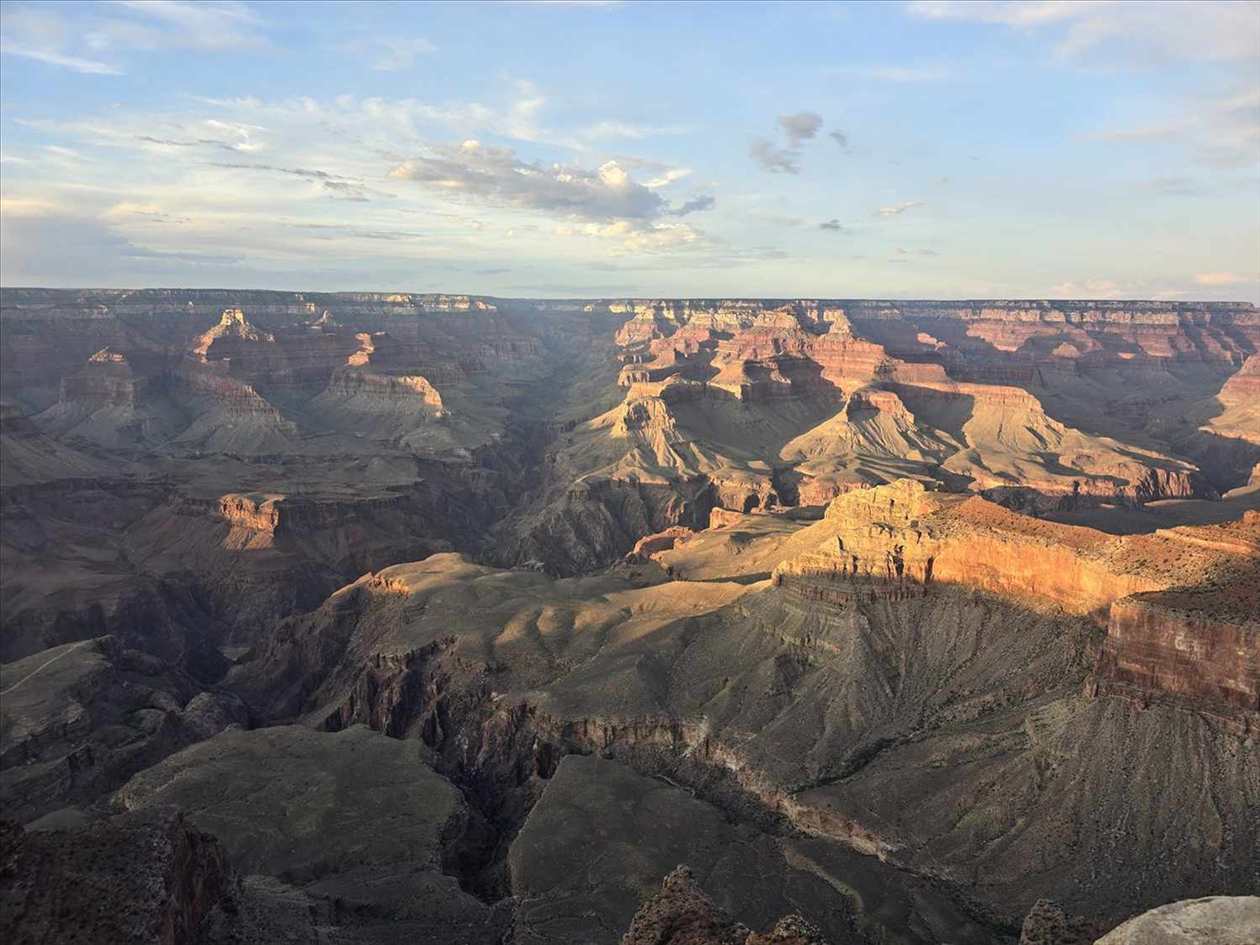
Grand Canyon National Park at a Glance
Grand Canyon National Park is one of the most recognizable landscapes on Earth — a mile-deep canyon carved by the Colorado River across nearly two billion years of exposed rock. Located in northern Arizona, it draws millions of travelers every year, from first-time visitors snapping their first rim-side photo to lifelong hikers descending into the inner canyon on multi-day backcountry trips. It's a place that manages to be both a bucket-list checkbox and, for many repeat visitors, something closer to a pilgrimage — a landscape that somehow looks different every time you return to it. Before diving into the details, here's the park at a glance:
UNESCO World Heritage Site
Designated 1979
Arizona, USA
Northern Arizona
Nearly 278 River Miles
Along the Colorado River
Up to 18 Miles Wide
Rim to rim
More Than 1 Mile Deep
At its deepest point
Nearly 5 Million Visitors
Every year
A Natural Wonder of the World
Commonly recognized (an informal designation)
Why Visit Grand Canyon National Park?
Photos and statistics only tell part of the story. Ask ten different visitors what stuck with them most, and you'll likely get ten different answers — which is part of what makes the canyon so hard to sum up in a single sentence. Here's what actually makes people fall in love with the Grand Canyon in person:
Incredible Scenery
Layered red rock stretching to the horizon in every direction — a view photographs can hint at but never fully capture.
Geological Significance
Rock layers exposing nearly two billion years of Earth's history, visible in a single glance from the rim.
Wildlife
From California condors soaring overhead to elk grazing near the rim, the park is alive with species found almost nowhere else.
Historic Landmarks
Century-old lodges, trails, and structures that tell the story of the park's earliest visitors and builders.
Cultural Importance
A landscape held sacred by Indigenous peoples for thousands of years, and still deeply connected to living communities today.
Photography
World-class light at sunrise and sunset make the canyon one of the most rewarding places on Earth to shoot.
Hiking
Trails ranging from easy rim walks to multi-day descents into the inner canyon, for every fitness level.
Family Experiences
Ranger programs, easy overlooks, and unforgettable first views make it a trip kids remember for life.
Why Grand Canyon National Park Is Unlike Any Other National Park
The United States is home to 63 national parks, each with its own claim to fame. But a handful of qualities set the Grand Canyon apart from all of them:
- One of the deepest canyons in the world — plunging more than a mile from rim to river, with walls that reveal nearly two billion years of exposed geological history.
- Ecosystems ranging from high-elevation pine forests on the rim to desert scrub along the canyon floor — a journey through multiple climate zones in a single trip.
- A landscape that has inspired Indigenous cultures for thousands of years, and remains deeply significant to living communities today.
- One of the world's premier destinations for geology, wildlife, hiking, photography, and stargazing — a combination few other parks can claim all at once.
- A view so vast and layered that no single photograph, or even a single visit, can fully capture it — part of why people return again and again.
It's this combination — scale, geological depth, biodiversity, cultural significance, and sheer visual drama — that makes the Grand Canyon not just a national park, but one of the defining natural landmarks on Earth. Other parks might match it on one or two of these fronts; almost none match it on all of them at once.
A Brief History of Grand Canyon National Park
The First Peoples
Long before the Grand Canyon became a national park, it was — and remains — home to Indigenous peoples. The Havasupai have lived within the canyon itself for centuries, in the village of Supai near Havasu Creek, while the Hopi, Navajo, Hualapai, Zuni, Yavapai-Apache, and other tribes hold deep cultural and spiritual ties to the region. Archaeological evidence, including ancestral Puebloan granaries and split-twig figurines found in canyon caves, shows human presence in the area dating back more than 4,000 years, long predating any European exploration.
Early Exploration
European exploration of the canyon began in 1540, when a Spanish expedition led by García López de Cárdenas, guided by Hopi scouts, became the first Europeans to see it — though it wasn't until John Wesley Powell's 1869 river expedition down the Colorado that the canyon gained wider national attention. Powell, who lost an arm in the Civil War, led a small crew through the entire length of the canyon by wooden boat, and his detailed accounts helped introduce the scale and grandeur of the canyon to the American public for the first time. Rail access followed in 1901, when the Santa Fe Railway reached the South Rim, making the canyon accessible to ordinary travelers for the first time and spurring the construction of El Tovar Hotel in 1905.
National Monument
In 1908, President Theodore Roosevelt — who had visited the canyon in 1903 and famously urged Americans to "leave it as it is" — designated it a national monument under the Antiquities Act, protecting it from mining and development while Congress debated permanent park status for more than a decade.
National Park Designation
After years of advocacy from conservationists, railroad interests, and early tourism boosters, Grand Canyon National Park was formally established on February 26, 1919, becoming the 17th U.S. national park and permanently protecting the canyon for future generations. Visitation was modest at first — around 44,000 people in its first year — a far cry from the millions who visit today.
UNESCO World Heritage Site
In 1979, the Grand Canyon was designated a UNESCO World Heritage Site, recognizing it as a landscape of outstanding universal value — one shared not just by the United States, but by the world, and placing it alongside sites like the Pyramids of Giza and the Great Barrier Reef on the list of places considered irreplaceable to humanity.
This is only a brief overview — for the full story, from ancient peoples through modern park history, see our complete History Guide →.
Geology That Spans Nearly Two Billion Years
The Grand Canyon is, above all, a geology lesson written in stone. Its walls expose nearly two billion years of Earth's history — layer upon layer of sedimentary, igneous, and metamorphic rock, each representing a different chapter of the planet's past. At the bottom of the canyon, the dark, twisted rock of the Vishnu Basement Rocks dates back roughly 1.8 billion years, among the oldest exposed rock anywhere on Earth. Moving upward, each layer tells its own story — ancient seas, deserts, and river deltas, all compressed into bands of red, orange, and cream-colored stone.
Standing at a South Rim overlook, you're actually looking at roughly a dozen major named rock layers stacked like a layer cake. Near the top, the pale Kaibab Limestone and Toroweap Formation formed from ancient seabeds. Below that, the cross-bedded Coconino Sandstone preserves the fossilized dunes of a Sahara-like desert that once covered the region, followed by the deep red Hermit Shale and Supai Group, laid down by ancient rivers and coastal plains. Further down, the sheer, rust-colored cliffs of Redwall Limestone — technically gray, but stained red by iron oxide washing down from layers above — give way to the Muav Limestone, Bright Angel Shale, and Tapeats Sandstone, each recording a different ancient shoreline. At the very bottom, the dark, twisted Vishnu Basement Rocks predate complex life on Earth entirely.
The canyon itself, however, is far younger than its rock. Most geologists estimate the Colorado River began carving the canyon we see today somewhere between five and six million years ago — remarkably fast on a geological timescale. The result is one of the most complete geological records on the planet: a rare place where nearly two billion years of Earth's history can be read from a single viewpoint.
This is just an introduction. For a deeper look at how each rock layer formed and what it reveals, visit our full Geology Guide →.
Wildlife of Grand Canyon National Park
Despite its extreme terrain and dramatic elevation changes, the Grand Canyon supports a surprising range of wildlife — from high-elevation forests on the rims to desert scrub along the canyon floor. That elevation change, from roughly 2,400 feet at the river to nearly 8,800 feet on the North Rim, packs five distinct ecological life zones into a single park — biologists have compared the change in plant and animal life from rim to river to the change you'd see driving from Mexico to Canada, all within about a mile of vertical descent.
- California Condors — one of the rarest birds in North America, reintroduced to the region in the 1990s after nearly going extinct; with wingspans over nine feet, they're often spotted soaring above the rim.
- Mule Deer — commonly seen grazing near overlooks and campgrounds, especially at dawn and dusk.
- Elk — large herds roam the South Rim, often wandering surprisingly close to trails and parking areas.
- Bighorn Sheep — sure-footed climbers occasionally spotted navigating steep canyon walls and inner-canyon trails.
- Coyotes — frequently heard at dusk, and occasionally seen trotting along rim trails or distant slopes.
- Hundreds of Bird Species — the park hosts over 355 recorded bird species, from tiny hummingbirds to golden eagles.
This is only a glimpse of the park's biodiversity — for a complete look at the species that call the canyon home, see our full Wildlife Guide →.
South Rim vs. North Rim: Which Should You Visit?
The Grand Canyon has two developed rims, and most first-time visitors are surprised to learn just how different a trip to each one looks — despite being only about 10 miles apart as the crow flies across the canyon, they're roughly 215 miles and a four-and-a-half-hour drive apart by road.
The South Rim is where the vast majority of visitors go — around 90% of the park's total visitation — and for good reason. It's open 365 days a year, has the most services, viewpoints, and lodging options, and sits closest to Sedona, Flagstaff, Williams, and Tusayan, making it the easiest rim to reach on a day trip. Iconic viewpoints like Mather Point, Hopi Point, and Desert View, along with historic stops like El Tovar and the Kolb Studio, are all found here.
The North Rim sits roughly 1,000 feet higher, which makes it noticeably cooler, greener, and far less crowded — but it comes with trade-offs. Its facilities close for the season from mid-October through mid-May due to snow, and its remote location makes it a longer, more deliberate trip for most travelers.
For most visitors, especially those planning a private guided day trip, the South Rim offers the more practical — and still every bit as breathtaking — way to experience the canyon.
Weather Throughout the Year
Weather at the Grand Canyon varies dramatically by season and elevation — the South Rim sits at roughly 7,000 feet, while the inner canyon can be 20—30 degrees warmer at any given time. Spring brings mild days and cool mornings, with occasional late-season snow at higher elevations. Summer is warm and sunny at the rim, but the inner canyon regularly exceeds 100°F, making midday hiking below the rim genuinely dangerous. Fall offers some of the most comfortable conditions of the year, with crisp air and thinning crowds. Winter transforms the rim into a quieter, snow-dusted landscape, with temperatures often in the 30s and 40s. Late summer also brings the North American monsoon, typically from early July through September, when afternoon thunderstorms build quickly over the canyon — dramatic to watch from a safe overlook, but a real hazard for anyone caught on an exposed trail.
For a full seasonal breakdown — including monthly temperatures and monsoon patterns — see our complete Weather Guide →.
Visiting During Every Season
Spring
Spring is one of the most popular times to visit, combining comfortable hiking weather with blooming wildflowers along the rim trails. Crowds build steadily through the season, with a notable spike around spring break in mid-March, so early mornings are especially rewarding this time of year.
Summer
Summer is peak season at the Grand Canyon — long days, full visitor services, and the busiest crowds of the year. It's also when afternoon monsoon storms are most common, adding dramatic skies to sunset views, even if it means keeping an eye on the weather during midday hours.
Fall
Fall is widely considered the sweet spot by frequent visitors — comfortable temperatures, golden cottonwoods on the drive in, and noticeably thinner crowds once September's holiday rush passes, making it a favorite among guides and repeat visitors alike.
Winter
Winter is the quietest season, and arguably the most photogenic for those willing to bundle up — snow dusting the canyon's red rock layers is a rare and striking sight, with a fraction of the year's typical crowds and some of the clearest, calmest air of the year.
For help deciding exactly when to plan your trip, see our full Best Time to Visit Guide →.
Things to Experience at Grand Canyon National Park
Experience the Canyon's Scenic Beauty
Few views on Earth rival the first moment of stepping up to a Grand Canyon overlook — mile after mile of layered rock stretching to the horizon, changing color with every shift in light. Whether it's a quick stop at a roadside pullout or a quiet sunrise moment at a favorite viewpoint, the scale of the canyon has a way of resetting your sense of perspective, no matter how many photos you've seen beforehand. Even guides who visit weekly will tell you the light never looks the same way twice — a passing cloud or a shift in the sun's angle can transform an overlook you've seen a hundred times.
Experience the Canyon's Wildlife
Watching a California condor ride a thermal along the rim, or spotting a herd of elk grazing just steps from a trailhead, adds a living, breathing dimension to the canyon's ancient landscape. Wildlife encounters here are often unplanned and unforgettable — a quiet reminder that this is a living ecosystem, not just a scenic backdrop. Even a short walk along a rim trail can turn up a surprising amount of life, from lizards sunning on the rocks to ravens riding the canyon's updrafts.
Experience the Night Sky
As one of the largest Dark Sky Parks in the world, the Grand Canyon offers a view of the night sky most visitors have never seen — thousands of stars, a visible Milky Way, and an almost total absence of light pollution. For many guests, the stars end up being just as memorable as the canyon itself. On a clear, moonless night, it's possible to see thousands more stars here than from almost any city in the country.
Experience the Rich History
From centuries-old Indigenous connections to the canyon to the historic lodges and trails built in the early 1900s, the park is layered with human history as deep as its geology. Standing at a century-old overlook, it's easy to imagine the first visitors seeing this same view for the very first time — and to appreciate how little the view itself has changed since then, even as the way we experience it has.
Experience the Geological Story
Nowhere else can you see nearly two billion years of Earth's history in a single glance. Each colored band in the canyon wall represents a different chapter of the planet's past — a story written in stone that becomes far more meaningful once you know how to read it. What looks at first like a simple, static rock wall reveals itself, layer by layer, as one of the most dramatic timelines on the planet.
Grand Canyon National Park Facts
For the readers who want the numbers without the narrative, here are the key facts that put the park's scale in perspective at a glance:
Founded
1908 as a national monument; 1919 as a national park
Size
About 1.2 million acres
Elevation
2,400 — 8,800 feet
Length
Nearly 278 river miles
Annual Visitors
Nearly 5 million
Animal Species
90+ mammals, 355+ birds
Frequently Asked Questions
Where is Grand Canyon National Park?
Grand Canyon National Park is located in northern Arizona, spanning roughly 1.2 million acres along both rims of the Colorado River. The South Rim, the most visited entrance, sits about 80 miles north of Flagstaff and 60 miles north of Williams, making it an easy day trip from either town, as well as from Sedona and Tusayan.
Why is it famous?
The Grand Canyon is famous for its sheer scale, its layered geology exposing nearly two billion years of Earth's history, and its status as one of the most photographed and recognized natural landmarks on the planet. It's commonly listed among the Seven Natural Wonders of the World, and its silhouette is instantly recognizable even to people who have never visited in person.
How old is it?
The canyon itself is estimated to be between five and six million years old, carved primarily by the Colorado River, though the rock layers exposed within its walls date back nearly two billion years — among the oldest exposed rock on Earth. In other words, the canyon is a relatively young feature carved into extraordinarily old rock.
When was it established?
The area was first protected as a national monument in 1908 by President Theodore Roosevelt, then formally designated Grand Canyon National Park on February 26, 1919, making it one of the oldest national parks in the United States.
How large is it?
The park covers approximately 1.2 million acres — roughly 1,900 square miles — making it larger than the state of Rhode Island.
Is it worth visiting?
Yes — for most travelers, the Grand Canyon delivers on its reputation, and often exceeds it. Few landscapes anywhere combine this scale, geological depth, and accessibility; even a short visit to a South Rim overlook offers a view unlike anywhere else on Earth. Guests who arrive expecting "just a big hole in the ground" are consistently surprised by how differently the canyon reads in person — the scale is simply hard to process from photos alone.
How many people visit every year?
Nearly five million people visit Grand Canyon National Park each year, making it one of the most visited national parks in the United States, behind only a handful of parks like Great Smoky Mountains and Zion.
Can you visit year-round?
Yes. The South Rim stays open 365 days a year, including holidays, with all major viewpoints and most services accessible even in winter. The North Rim, at a higher and snowier elevation, typically closes for the season from mid-October through mid-May.
Continue Exploring the Grand Canyon
Ready to go deeper? These guides cover everything from timing your trip to reading the rock layers.
Best Time Guide
Season by season — when to visit for the best weather and thinnest crowds.
READ GUIDE →Weather Guide
Temperatures, seasons and monsoon patterns.
READ GUIDE →Packing Guide
Everything to bring, season by season.
READ GUIDE →Photography Guide
Best viewpoints, light, and camera settings for iconic shots.
READ GUIDE →History Guide
From ancient peoples to national park designation.
READ GUIDE →Geology Guide
Nearly two billion years of exposed rock, explained.
READ GUIDE →Wildlife Guide
Animals that call the canyon home.
READ GUIDE →
Experience Grand Canyon National Park with Grand Canyon Journeys
Grand Canyon National Park is one of the world's most extraordinary destinations, offering breathtaking scenery, remarkable geology, fascinating wildlife, and a rich cultural history. Our private tours allow you to experience the park comfortably, learn from experienced local guides, and enjoy a personalized day tailored to your interests.
Grand Canyon Photography Tour
Golden-hour light, guided — from $349
VIEW TOUR →
However you choose to see it, Grand Canyon National Park rewards time and attention — the more you understand about its history, geology, and wildlife, the more the view in front of you comes to life. This page is just a starting point; the guides below go much deeper into every part of the story.